Introduction: The Strategic Value of a Well-Executed Ice Breaker
Tired of awkward silences at the start of meetings? Looking for a simple, fun way to get a group to connect? Enter Two Truths and a Lie, the undisputed champion of ice breaker games. This classic activity is brilliantly simple yet incredibly effective at turning a room of strangers into a group of engaged, laughing participants.
Part 1: Core Principles and Rules of the Game
Official Rules for Two Truths and a Lie
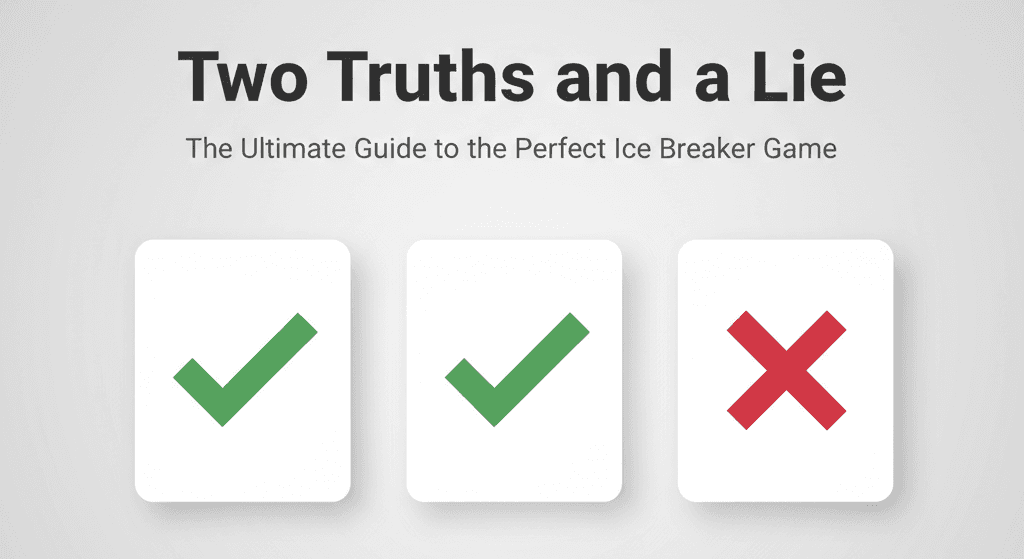
Two Truths and a Lie is a verbal communication and deduction game. The core objective is for participants to correctly identify a fabricated statement among two true ones.
The standard two truths and a lie game follows these established parameters:
-
Statement Requirements: Each participant prepares three personal statements
- Two factual statements that are verifiably true
- One deceptive statement that appears plausible
- All statements should be delivered with equal conviction
-
Game Sequence:
- Presentation of all three statements
- Group questioning period (1-2 minutes)
- Secret ballot or show-of-hands voting
- Revelation of the actual lie
- Optional discussion of interesting truths
-
Time Allocation:
- Preparation: 3-5 minutes for statement development
- Per participant: 4-6 minutes total
- 10-person group: 45-60 minutes complete session
The fundamental structure of two truths and a lie creates a safe container for personal disclosure while maintaining engaging gameplay dynamics.
Part 2: Advanced Strategy for Crafting Statements
The Core Principle: Invert Expectations
The most effective approach to two truths and a lie involves strategic inversion of participant expectations. Extraordinary truths should appear deceptive, while carefully constructed lies should seem entirely plausible. This cognitive dissonance drives engagement throughout the two truths and a lie activity.
Tactical Tips for Statement Construction:
For Truth Statements:
- Incorporate specific, verifiable details (dates, locations, names)
- Select lesser-known but demonstrable personal achievements
- Balance extraordinary claims with mundane verifications
For Lie Statements:
- Create plausible falsehoods that align with participant demographics
- Include specific but unverifiable contextual details
- Leverage common experiences with slight alterations
Delivery Techniques:
- Maintain consistent vocal tone and body language across all statements
- Prepare ancillary details for potential questioning
- Avoid common "tells" such as hesitation or excessive smiling
Mastering these strategic elements will significantly enhance the effectiveness of your two truths and a lie facilitation.
Part 3: A Curated Library of Examples
Category A: Professional & Corporate Settings
-
I once presented to a board of directors while battling food poisoning
-
I have never missed a project deadline in my current role
-
I secretly hold a professional sommelier certification
-
I managed a cross-functional team of 20 people on a high-stakes project
-
I have never used the "reply all" function inappropriately
-
I am fluent in three programming languages
Category B: Personal Background & History
-
I was born in a hospital that no longer exists
-
I have never broken any bones despite being accident-prone
-
I won a regional science fair with a project on soil erosion
-
I still possess every diary I've kept since age 10
-
I have never learned to properly whistle
-
I was named after my great-grandmother's favorite literary character
Category C: Unique Experiences & Achievements
-
I once appeared as an extra in a major television series
-
I have never owned a smartphone despite working in tech
-
I volunteered for six months at wildlife rescue sanctuary
-
I successfully completed a silent meditation retreat
-
I have never eaten at a fast-food restaurant
-
I hold a Guinness World Record for most socks worn simultaneously
Category D: Travel & Adventure
-
I've slept in a castle that dates back to the 12th century
-
I have never traveled outside my home country
-
I got lost for hours in the Paris catacombs
-
I've visited every continent except Antarctica
-
I have never seen the ocean in person
-
I survived a 24-hour delay in a foreign airport with no luggage
Category E: Skills, Hobbies & Talents
-
I can solve a Rubik's Cube in under 90 seconds
-
I have never learned to ride a bicycle
-
I play four musical instruments at intermediate level
-
I'm certified in wilderness first aid and rescue
-
I have never successfully parallel parked a vehicle
-
I can identify 50 different bird species by song alone
This curated collection provides immediate starting points for participants struggling with statement creation for their two truths and a lie contributions.
Part 4: Variations and Best Practices
Enhanced Game Formats
Timed Two Truths and a Lie:
- 60-second statement preparation
- 30-second questioning periods
- Ideal for large groups or time-constrained sessions
Themed Two Truths and a Lie:
- Category restrictions (work experiences, travel stories, childhood memories)
- Forces creative thinking within constraints
- Creates cohesive narrative arcs
Team-Based Two Truths and a Lie:
- Small groups collaborate on statement development
- Builds intra-team connection before inter-team competition
- Enhances creative output through collaboration
Facilitator's FAQ
Q: How do I handle participants who struggle with statement creation?
A: Provide example lists from Category A-E above and encourage pairing ordinary with extraordinary statements.
Q: What's the ideal group size for Two Truths and a Lie?
A: 6-12 participants allows depth without exhaustion. For larger groups, use breakout sessions.
Q: How virtual-friendly is the Two Truths and a Lie format?
A: Extremely adaptable. Use polling features for voting and breakout rooms for larger virtual groups.
Q: What if someone's lie is easily detected?
A: Use it as a learning opportunity about statement construction for future rounds of Two Truths and a Lie.
Conclusion: A Tool for Building Connection
The sophisticated implementation of Two Truths and a Lie transforms this simple game into a powerful facilitation tool. The strategic approach to Two Truths and a Lie outlined in this guide will elevate your icebreaker sessions from obligatory activities to meaningful team-building experiences. When facilitators master the nuances of Two Truths and a Lie, they unlock its full potential for creating authentic connections and strengthening group cohesion across diverse teams and settings.